Figuring Out How to Play
Playing the Bass, Explained
In the previous entry I explained how a "song" works, and roughly how a bass works, and included pictures of my new bass and a description of learning how to play roughly 30% of my Spotify play list. A little more detailed description of how to play a bass is necessary. If this bores you, you may want to move on to the next entry which will detail a few of the early bands I was in, with pics and a few Soundcloud recordings (if I figure out how to upload songs to Soundcloud).
As I described in the first blog of this series, when they teach you to play music in the school system, they only teach you to read and play the notes as written, and to behave yourself and don't cause problems. But they don't really teach you why you are playing the specific notes that you are, or why the composer arranged the bass line in that way. So you have to just know or figure it out.
I talked about this a little in the second entry. The bass essentially plays the chords of the progression one note at a time. So you have to understand how to play a chord on a bass. This is my crazy, simplified version of how to play every possible chord on a bass.
Since each string is 5 chromatic half steps apart, then a major chord can only be played 5 possible ways on a bass. I looked on Youtube for a short vid describing chords on a bass, and by gads these people over-complicate things. Again, a major chord is root, 3rd, and 5th. When played in order with the octave it's called an arpeggio, but the bass line can be played in any order (as long as you hit the root on the first beat of the measure, called "on the one"), and the brain just figures it out because its basically dyslexic anyway. And here is the best vid I found on youtube to describe it. Its a bit too long and convoluted, but it does give you the sound of an arpeggio, major and minor.
The strings played open on a bass (fingering position 0), are E (the low string, nearest the bassist face), A, D, and G (farthest away and highest pitched)
To play a chord that begins at finger position 0, say and E (or an A) arpeggio, first play the zero position of the E (or A) string, then the 4th position of the same string, then the 2nd position of the next string and the 2nd position of the string above that. And since I don't want to waste time learning any damn drawing software, I just drew a 0-4-2-2 with a pencil:
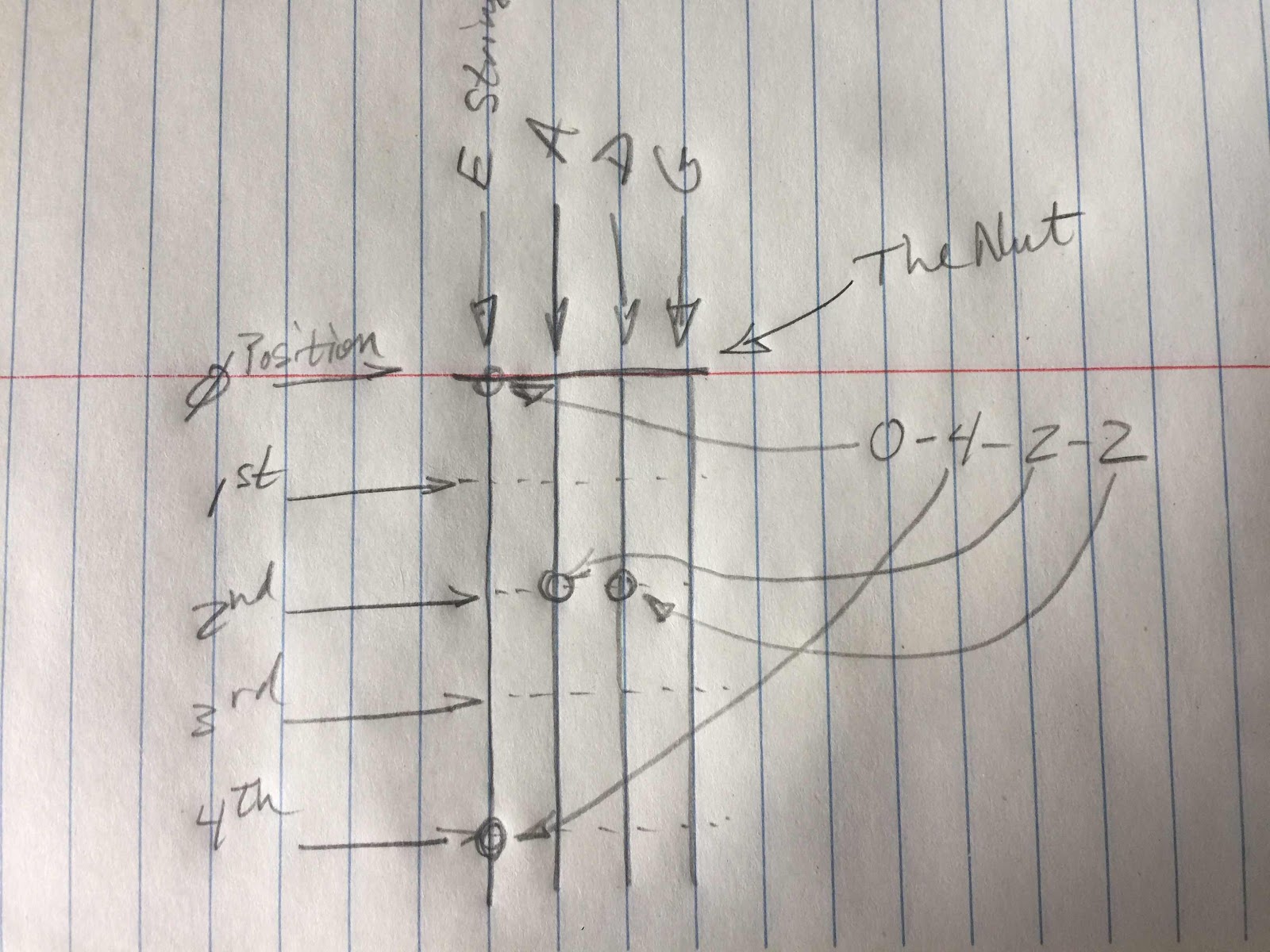
Notice that any increasing number is played on the same string as previous, and any decreasing or same number is played on the next string up (away from you face). Also notice that this same pattern can be played starting on the A string to play an A arpeggio. But if you try starting on the D string you'll run out of strings. I may explain how to deal with that later, but probably not.
Here's a 1-0-3-3:

Pretty simple. And the 2-1-4-4 is identical but one position further down on each note. Notice that in the case of the 2-1-4-4 no note is played on the zero position, or stated another way, the entire chord is played "off the nut". Now, here's the critical piece of information: Any chord that is played entirely off the nut can be played anywhere on the neck in the same shape (or pattern). It is still a major chord, but the root or chord has changed. Notice the checkmark shape. You will play that one a lot. All over the neck. The advantage of playing chords on the nut is they are faster to play with some open (or zero position) fingerings, and the tune of the note is usually more accurate closer to the nut.
There you go, you can now play any major chord on a bass. And to play a minor, you only have to move the third (the second note in all of the arpeggios) one position toward the nut. 3-2-0-0 (major) becomes 3-1-0-0 (minor). 2-1-4-4 becomes 2-0-4-4, a longer check mark. Ok, minors covered.
Now, this is just about as far as any neophyte learning music out of a book ever gets. They learn the chords and then say "now what?" Ok, now we're going to learn how to listen to and dissect songs.
We'll start off with a useful lie: "All American music follows the I-IV-V chord pattern." It's not absolutely true, but is true about 50% of the time. What the hell does that mean? In old-time music notiation, "I" represents the root chord or key of the entire song. "IV" then represent the 4th chord above the root chord, and V is the fifth chord above the root. All major. So lets say the key of the song is in A (that chord on the bass is played 0-4-2 -- no need to play the octave -- off the A string). You play that chord for a while, then move to the IV chord, a 0-4-2 off of the D string. Same pattern, just one string up. Then eventually, usually at the end of the phrase, the V chord, which is an E, played beginning at the 2nd position of the D string as 2-1-4. A prime example of this chord progression is the song "Blue Moon of Kentucky"
This is a nice vid because it shows the bassman fingering a I-IV-V in C, which means a 3-2-0 on the A string, a 3-2-0 on the D string, and a 0-4-2 on the G string. But wait, you cant play a 0-4-2 on the G string. It's the top string. Also note that the bass player is not playing a root-3rd-5th at all. Instead he's playing only a root and a 5th below the root. Cool thing about the bass. The 5th of any chord is one string down (toward you face) and the same position as any root. So the bass player in the vid is playing the C at 3rd position on the A string and the 5th at 3rd position on the E string. This is known as playing the bass "root-fifth". It's an easy/lazy way to play any chord because you don't play the 3rd at all, which means you don't care if it's a minor chord. This style is virtually required on all bluegrass and old time music because the form requires the bass to play the root on the first note of the measure, or "the one", and the 5th on "the three", with the guitars and other rhythm instruments chunking the whole chord on the two and the four.
This is why you learn bluegrass first. It's a simple rhythm root-fifth with few chords. This is the foundation of American music -- "Three chords and the truth". A side effect of this is that guitars who wish to simplify their playing to allow them to focus on singing the melody will use a "capo" -- a clamp that goes on any fret across the neck of the guitar -- to allow them to play any song using G, C and D fingerings but the capo changes the tune of the guitar to the desired key. This only becomes a problem when the guitars yell out the chords of a new song without considering that they have a capo on. The bass never uses a capo but plays in the correct key all the time.
Not all songs are I-IV-V, but we'll cover that later. Or not. It's not actually all that complex.
So, we played American music that way for a while, but then Elvis and the Beach Boys came along. How did that change things? The standard chord progression of rock and roll is -- you guessed it -- I-IV-V. The only change is the rhythm. Here's a Beach Boys tune -- standard chord progression, but the bass plays each chord with the root-3rd-5th-and "6th" on the quarter notes and the rhythm guitar and drums do a double hit on the two and a single hit on the four. That's just the gimmick with this song:
Ditto Little Deuce Coupe, but with slightly different rhythm on the guitar and drums.
This is the most important thing to understand about music and the bass:
Ray Brown, famous bassist that used to play at the Lionel Hampton Jazz Festival just about every year once said:
"To play the bass, you must have every song known to man memorized. Fortunately, this is not difficult."
And the above description is why. Every song can be reduced to a phrase like: "It's a I-IV-V in G where the chords are played root-3rd-5th-6th on the quarter notes." You don't ever memorize notes or absolute chords. You memorize relative chords (where does it go from here?) and rhythms. In that way you can transpose any song to any key on the fly and the rhythm should be reminiscent of the tune in question, but not exact. "You want it in E? No problem."
Oh yeah, here's Elvis' Jailhouse rock, A I-IV-V with the bass playing root on the one, the 3rd on the "and of two", and the 5th on the four:
This thought process is why I was able to pick up the bass in my mid-40s and learn to play it (relatively) quickly. All I had to do was develop new neural pathways in my brain to control my fingers to make the notes I desired in their proper time. It took me six months of practice to get good enough to try playing in my first group. For six months I just left the bass out in the playroom and whenever I walked by I would try to play seven or eight songs on my playlist.
My first group, tomorrow.
In the previous entry I explained how a "song" works, and roughly how a bass works, and included pictures of my new bass and a description of learning how to play roughly 30% of my Spotify play list. A little more detailed description of how to play a bass is necessary. If this bores you, you may want to move on to the next entry which will detail a few of the early bands I was in, with pics and a few Soundcloud recordings (if I figure out how to upload songs to Soundcloud).
As I described in the first blog of this series, when they teach you to play music in the school system, they only teach you to read and play the notes as written, and to behave yourself and don't cause problems. But they don't really teach you why you are playing the specific notes that you are, or why the composer arranged the bass line in that way. So you have to just know or figure it out.
I talked about this a little in the second entry. The bass essentially plays the chords of the progression one note at a time. So you have to understand how to play a chord on a bass. This is my crazy, simplified version of how to play every possible chord on a bass.
Since each string is 5 chromatic half steps apart, then a major chord can only be played 5 possible ways on a bass. I looked on Youtube for a short vid describing chords on a bass, and by gads these people over-complicate things. Again, a major chord is root, 3rd, and 5th. When played in order with the octave it's called an arpeggio, but the bass line can be played in any order (as long as you hit the root on the first beat of the measure, called "on the one"), and the brain just figures it out because its basically dyslexic anyway. And here is the best vid I found on youtube to describe it. Its a bit too long and convoluted, but it does give you the sound of an arpeggio, major and minor.
Notice that this guy plays "off the nut" (the nut is the ridge through which the top of the strings go the to the tuner knobs), meaning he plays in the middle of the neck. I taught myself to play ON the nut for two reasons. 1) It's hard to exactly find, say, the 7th position on a fretless neck (all acoustic basses are fretless), and the closer the to nut, the more likely you will hit the note correctly in tune, and 2) You can play much faster with open fingerings (position zero) in the run. So, here are the 5 possible major chord arpeggio fingerings on a bass:
0-4-2-2
1-0-3-3
2-1-4-4
3-2-0-0
4-3-1-1
The strings played open on a bass (fingering position 0), are E (the low string, nearest the bassist face), A, D, and G (farthest away and highest pitched)
To play a chord that begins at finger position 0, say and E (or an A) arpeggio, first play the zero position of the E (or A) string, then the 4th position of the same string, then the 2nd position of the next string and the 2nd position of the string above that. And since I don't want to waste time learning any damn drawing software, I just drew a 0-4-2-2 with a pencil:
Notice that any increasing number is played on the same string as previous, and any decreasing or same number is played on the next string up (away from you face). Also notice that this same pattern can be played starting on the A string to play an A arpeggio. But if you try starting on the D string you'll run out of strings. I may explain how to deal with that later, but probably not.
Here's a 1-0-3-3:
Pretty simple. And the 2-1-4-4 is identical but one position further down on each note. Notice that in the case of the 2-1-4-4 no note is played on the zero position, or stated another way, the entire chord is played "off the nut". Now, here's the critical piece of information: Any chord that is played entirely off the nut can be played anywhere on the neck in the same shape (or pattern). It is still a major chord, but the root or chord has changed. Notice the checkmark shape. You will play that one a lot. All over the neck. The advantage of playing chords on the nut is they are faster to play with some open (or zero position) fingerings, and the tune of the note is usually more accurate closer to the nut.
There you go, you can now play any major chord on a bass. And to play a minor, you only have to move the third (the second note in all of the arpeggios) one position toward the nut. 3-2-0-0 (major) becomes 3-1-0-0 (minor). 2-1-4-4 becomes 2-0-4-4, a longer check mark. Ok, minors covered.
Now, this is just about as far as any neophyte learning music out of a book ever gets. They learn the chords and then say "now what?" Ok, now we're going to learn how to listen to and dissect songs.
We'll start off with a useful lie: "All American music follows the I-IV-V chord pattern." It's not absolutely true, but is true about 50% of the time. What the hell does that mean? In old-time music notiation, "I" represents the root chord or key of the entire song. "IV" then represent the 4th chord above the root chord, and V is the fifth chord above the root. All major. So lets say the key of the song is in A (that chord on the bass is played 0-4-2 -- no need to play the octave -- off the A string). You play that chord for a while, then move to the IV chord, a 0-4-2 off of the D string. Same pattern, just one string up. Then eventually, usually at the end of the phrase, the V chord, which is an E, played beginning at the 2nd position of the D string as 2-1-4. A prime example of this chord progression is the song "Blue Moon of Kentucky"
This is a nice vid because it shows the bassman fingering a I-IV-V in C, which means a 3-2-0 on the A string, a 3-2-0 on the D string, and a 0-4-2 on the G string. But wait, you cant play a 0-4-2 on the G string. It's the top string. Also note that the bass player is not playing a root-3rd-5th at all. Instead he's playing only a root and a 5th below the root. Cool thing about the bass. The 5th of any chord is one string down (toward you face) and the same position as any root. So the bass player in the vid is playing the C at 3rd position on the A string and the 5th at 3rd position on the E string. This is known as playing the bass "root-fifth". It's an easy/lazy way to play any chord because you don't play the 3rd at all, which means you don't care if it's a minor chord. This style is virtually required on all bluegrass and old time music because the form requires the bass to play the root on the first note of the measure, or "the one", and the 5th on "the three", with the guitars and other rhythm instruments chunking the whole chord on the two and the four.
This is why you learn bluegrass first. It's a simple rhythm root-fifth with few chords. This is the foundation of American music -- "Three chords and the truth". A side effect of this is that guitars who wish to simplify their playing to allow them to focus on singing the melody will use a "capo" -- a clamp that goes on any fret across the neck of the guitar -- to allow them to play any song using G, C and D fingerings but the capo changes the tune of the guitar to the desired key. This only becomes a problem when the guitars yell out the chords of a new song without considering that they have a capo on. The bass never uses a capo but plays in the correct key all the time.
Not all songs are I-IV-V, but we'll cover that later. Or not. It's not actually all that complex.
So, we played American music that way for a while, but then Elvis and the Beach Boys came along. How did that change things? The standard chord progression of rock and roll is -- you guessed it -- I-IV-V. The only change is the rhythm. Here's a Beach Boys tune -- standard chord progression, but the bass plays each chord with the root-3rd-5th-and "6th" on the quarter notes and the rhythm guitar and drums do a double hit on the two and a single hit on the four. That's just the gimmick with this song:
Ditto Little Deuce Coupe, but with slightly different rhythm on the guitar and drums.
This is the most important thing to understand about music and the bass:
Ray Brown, famous bassist that used to play at the Lionel Hampton Jazz Festival just about every year once said:
"To play the bass, you must have every song known to man memorized. Fortunately, this is not difficult."
And the above description is why. Every song can be reduced to a phrase like: "It's a I-IV-V in G where the chords are played root-3rd-5th-6th on the quarter notes." You don't ever memorize notes or absolute chords. You memorize relative chords (where does it go from here?) and rhythms. In that way you can transpose any song to any key on the fly and the rhythm should be reminiscent of the tune in question, but not exact. "You want it in E? No problem."
Oh yeah, here's Elvis' Jailhouse rock, A I-IV-V with the bass playing root on the one, the 3rd on the "and of two", and the 5th on the four:
This thought process is why I was able to pick up the bass in my mid-40s and learn to play it (relatively) quickly. All I had to do was develop new neural pathways in my brain to control my fingers to make the notes I desired in their proper time. It took me six months of practice to get good enough to try playing in my first group. For six months I just left the bass out in the playroom and whenever I walked by I would try to play seven or eight songs on my playlist.
My first group, tomorrow.


Comments
Post a Comment